A Living Room Office That Still Feels Like a Living Room
Most living rooms can find space for a desk. The harder thing is keeping the room recognisable once the desk arrives. A monitor facing the sofa, a chair left in the middle of the floor and a charging cable trailing toward the only free socket can turn the room where you relax into the room where you never quite stopped working. The goal of a living room office is a work corner that belongs to the living room when the screen is off.
That depends less on hiding the desk than on deciding what the rest of the room sees. From the sofa, you notice the front of a screen far more than the side of a desk. You notice a chair that blocks the walk to the window, a laptop left open on the coffee table, a power strip lying across the rug. Each of those is a small layout decision, and each can be made in favour of the evening without making the working day worse.
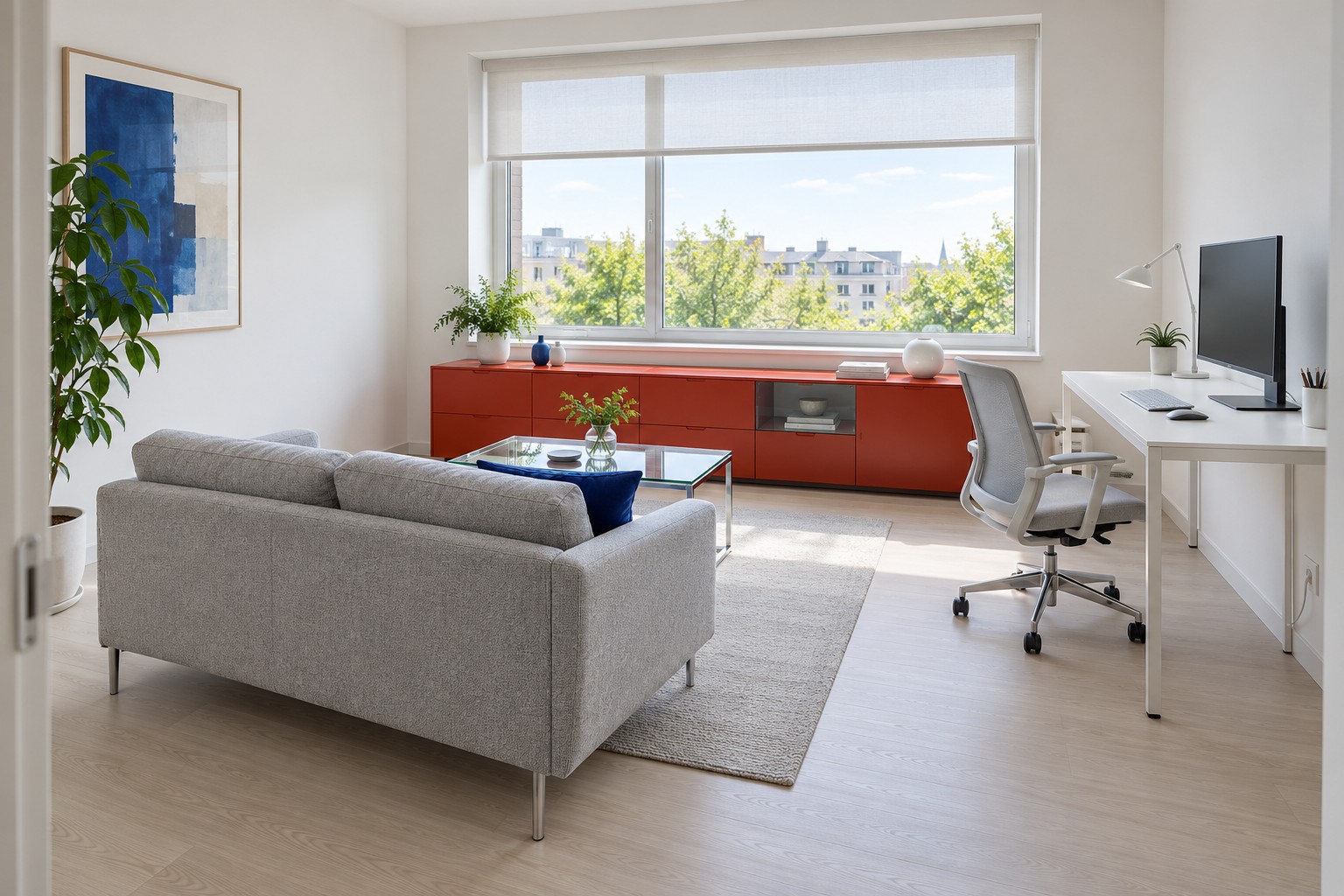
Image credit: pxef.com. AI-generated design concept.
The illustration shows the work corner beside a grey sofa, a glass coffee table and a long vermilion cabinet below the window. The monitor and light chair occupy the right-hand wall, leaving the sofa as the room’s central piece of seating. White steel legs, chrome details and one blue cushion give the small room a contemporary identity without filling its surfaces. This proposal places a genuine desk against the side wall of a living room, close to the window, with the sofa facing the window wall rather than the desk. The design assumptions are a room of 3.8 by 4.5 metres, about 12.5 by 14.8 feet, a desk of 130 by 70 centimetres, roughly 51 by 28 inches, on a slim white steel frame, a two-seat sofa, a small coffee table and a run of low lacquered vermilion storage beneath the window. Clear glass appears in the coffee table top and in one cabinet front. These figures describe the concept, not a surveyed apartment, and the illustration is meant to show the relationship between the two activities rather than certify exact clearances.
The orientation is the main decision. With the sofa looking toward the window and the desk on the right-hand wall, the person working faces that wall and has daylight on their left. The screen therefore points across the room, at right angles to the sofa’s line of sight. From the sofa you see the edge of a monitor and the side of a desk, which reads as furniture. Turn the same desk around so the screen faces the seating and every switched-off evening presents a large dark rectangle at the centre of the view. If the room makes that orientation impossible, a lower screen position or a laptop that closes may matter more than any styling choice.
Depth is where living room desks are most often compromised. A console table is tempting because it looks light and finished against a wall, but many are built for a lamp, a bowl of keys and a few books. Take a 35 centimetre console as an example. A monitor stand might need around 20 to 25 centimetres front to back, depending on the model, and a keyboard another 13 or so before you have left any room for your forearms or a notebook. On paper the numbers almost fit; at the chair, the screen ends up uncomfortably close and the keyboard hangs at the front edge. The 70 centimetre depth in this proposal leaves room for a stand at the back, a keyboard in the middle and an open notebook or forearm space at the front. Check your own equipment, but treat a decorative console as a laptop shelf, not a full workstation.
The slim freestanding desk is still a piece of living room furniture. Its white steel frame keeps it visually light, the top is a quiet matte surface rather than a glossy one that reflects the window, and nothing about it shouts office. That matters because the desk stays out after work. The proposal does not try to fold it away. It tries to make the desk worth looking at.
The chair is the object most likely to spoil that. An office chair left wherever you stood up sits in the middle of the room all evening, usually in someone’s route. Plan a parked position. In this layout the chair slides in under the window end of the desk, where its back faces the wall and its base stays out of the space between the coffee table and the desk. Check that the armrests clear the underside of the top; if they do not, the parked position needs a different spot along the wall, not a promise to remember to move it. The chair also needs a working position. When you pull back to stand up, it moves into the open floor between the desk and the coffee table. Sit there, push back, stand and walk to the window with the chair still out. That occupied route is the one to protect, because it is the one you will use at four in the afternoon.
Storage is where the room either stays a living room or becomes an office with a sofa in it. The low vermilion unit under the window does two jobs. The end nearest the desk holds work: a drawer for the laptop and its charger when they are not in use, a shallow tray for the current papers, a box for the headset. The far end holds living room things, such as remote controls, games or blankets. One long, deliberate piece of furniture serves both without a visible boundary, and its strong colour gives the room a focus that has nothing to do with work. A closed front matters more than a lockable one here. You want the end of the day to remove evidence, not to perform security.
Power deserves the same honesty. A desk needs a socket within comfortable reach, ideally close enough that the charger and monitor can stay plugged in behind the storage rather than across the floor. Keep cables out of the walking route and out from under the rug. If the only available outlet is on the opposite side of the room, that is a real constraint and may decide where the desk goes before style gets a vote. A neat-looking extension lead across the threshold of the sofa area is the kind of compromise that becomes a daily trip hazard.
Light behaves differently for each use. During the day, side daylight from the window suits the screen and lets the desk feel part of the bright end of the room. For evening work, a task lamp on the desk lights the notebook, while a separate floor or table lamp near the sofa looks after the living area. Keeping the two switched independently is the simplest way to tell the room which mode it is in. When the task lamp goes off, the corner recedes. Our guide to planning around the working day covers how those routines shape the furniture in the first place.
Walk through a working day in this arrangement. You sit at the desk with the window on your left, the screen facing across the room, papers in the tray within reach of the chair. Someone else in the household can still reach the window along the far side of the sofa without passing between you and the screen. At lunch you can leave the desk as it is. Calls are the less comfortable part: the camera looks back across the living room, so check what it shows, and accept that an open-plan room offers no acoustic privacy when others are home.
Then walk through the evening. The laptop goes into its drawer, the papers into the tray, the headset into its box. The task lamp goes off and the chair slides into its parked position. The monitor stays, switched off and seen side-on from the sofa. The desktop is free for a book or a plant if you like, though there is no obligation to dress it. What changes most is the absence of loose equipment. A living room with a desk in it looks perfectly ordinary. A living room with a laptop on the coffee table and a charger on the arm of the sofa looks like a workday that never ended.
There is a real compromise in this proposal. The desk takes the best stretch of wall near the window, which in many living rooms might otherwise hold a reading chair. Someone who rarely works at home may prefer to give that spot to the chair and accept a pack-away setup, along the lines of our studio dining table approach. Someone who works there every day will usually find the permanent desk worth the trade, because it ends the daily negotiation over where the work goes.
Before buying anything, borrow a table of similar size and put it where the desk would stand. Work there for a day. Then sit on the sofa in the evening and look at what you see. If the answer is a dark screen and a tangle of cable, change the orientation or the storage before you change the furniture. When the answer is a side table, a parked chair and a strong red cabinet under the window, you have a living room that happens to contain a good office.