A Home Office for Reading Writing and Occasional Calls
Most home office advice assumes the screen is the centre of the work. For a writer, a researcher, an editor or anyone whose day is mostly reading and making notes, that assumption puts the wrong thing in the middle of the desk. The laptop matters, but it is used in bursts. What fills the hours is an open book, a notebook, a few printed pages and a pen, and those need a clear surface, good light and somewhere to go when they are not in use.
So design the desk for the activity that takes most of the time, and let the computer visit. That sounds obvious, but it changes several decisions at once: where the laptop sits, what the lamp lights, how much free surface the desk keeps and which books deserve to be within reach. It also changes how calls work, because a desk arranged around paper needs a short, repeatable way to become presentable on camera.
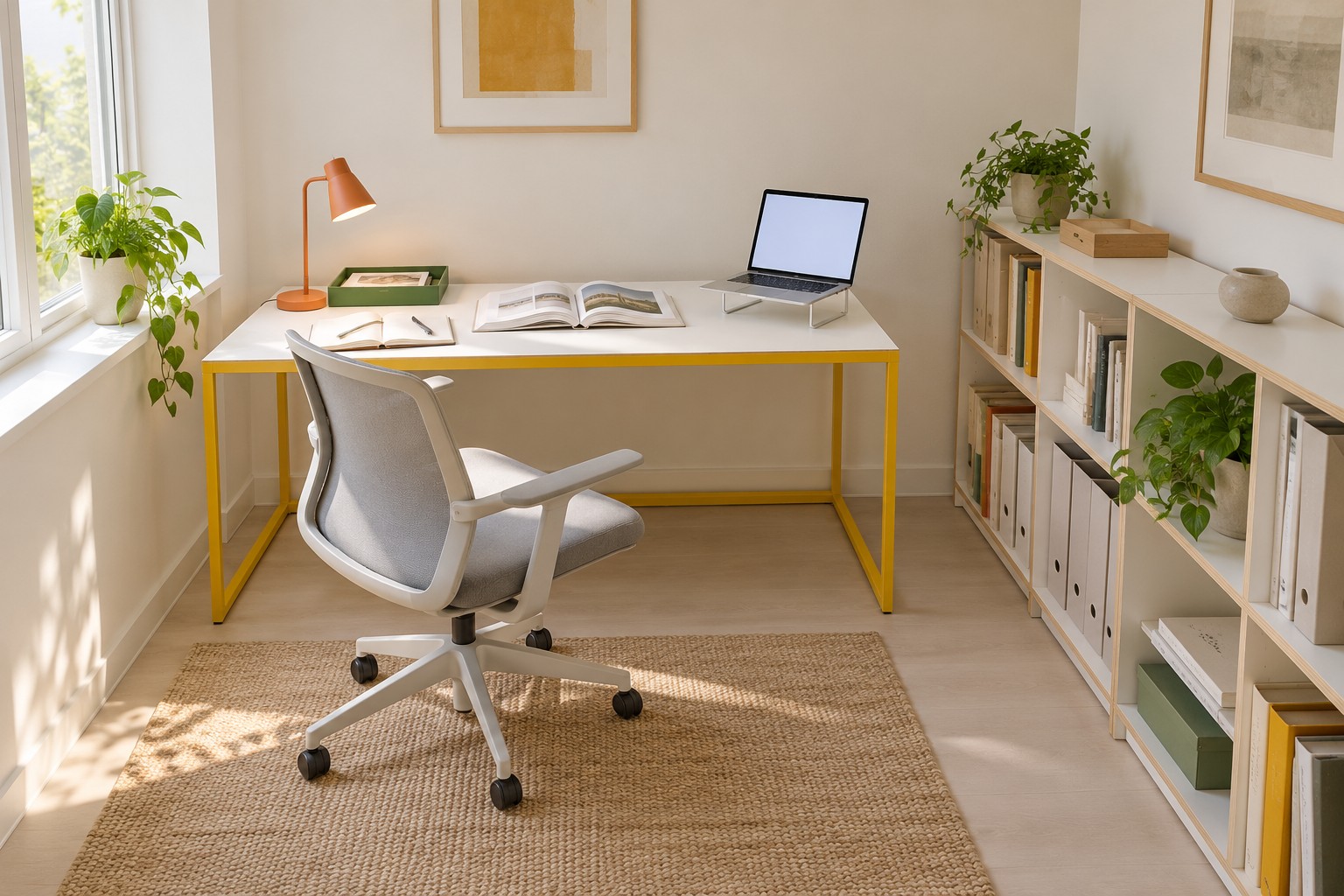
Image credit: pxef.com. AI-generated design concept.
This proposal is a small study of 2.8 by 3.2 metres, about 9.2 by 10.5 feet, with a window on the left wall. A matte white desk of 140 by 75 centimetres, roughly 55 by 30 inches, stands on a thin yellow steel frame against the far wall, so daylight arrives from the worker’s left. The centre of the desk is left open for an open book and a notebook. A modest laptop sits on a stand toward the right-hand end. A green tray at the back left holds current papers. Beside the desk, low modular book storage runs along the right-hand wall at roughly desk height, and a small orange lamp stands on the desk. The room borrows from Scandinavian and Japanese design in its pale surfaces, low furniture and lack of visual clutter. These dimensions and choices are design assumptions for the concept.
The yellow frame draws a clean line around the white worktop. An open illustrated book lies toward the back, with the notebook and pen nearer the front-left edge; the orange lamp and green tray occupy the window end. The laptop stays at the opposite end on a slender metal stand. White-fronted, pale-edged cubbies along the side wall hold books upright, leaving the desktop’s centre for the pages actually being used.
The writing area is the most valuable part of the desk, and it should stay clear. In this layout, about 70 centimetres in the middle of the desk is free, enough for an open hardback, which can easily spread 30 to 40 centimetres, and a notebook beside it. The 75 centimetre depth matters here. It lets the book sit slightly farther back than the notebook, so you can read one while writing in the other without the two overlapping. A book that will not stay open on its own can lie under a simple weight or in a low reading stand. A tall lectern-style stand looks romantic and takes a lot of space; for most reading, the desk is the stand.
The laptop sits to the side because it is used to the side. When you are reading and writing by hand, the screen is a reference, glanced at to check a fact or a source. On a stand at the right-hand end of the desk, it is visible without dominating. When a typing session begins, slide the stand to the centre and use a separate compact keyboard and mouse, kept in the drawer or in the tray when not needed. That arrangement keeps the screen at a more comfortable height for longer sessions than typing directly on the laptop, and it means the computer does not have to be packed away entirely each time the work changes.
The current-paper tray solves a problem every reading-heavy desk has: the pages that are part of today’s work but not in use right now. Printed articles, marked-up drafts and notes from yesterday need somewhere to wait that is not on top of the open book. A shallow green tray at the back of the desk holds them in sight. At the end of the day, the open book goes on top of the tray or back on the shelf, and the notebook closes. A tray that holds a working stack, not an archive, keeps the system honest.
Task light needs to fall on the page, not on the screen. The small orange lamp in this concept sits on the desk and directs light down onto the writing area. Where it stands depends on which hand you write with, because the lamp should come from the side opposite your writing hand so your own hand does not cast its shadow over the line you are writing. In this concept, written for a right-handed user, it stands on the left, the same side as the window; a left-handed writer would move it to the right. Check the screen too. A lamp that lights the page beautifully can also put a bright reflection on the laptop when it moves to the centre, so aim it down and try both positions.
Books deserve more thought than decorative shelving usually gets. The useful distinction is between the books you are using and the books you own. Active books, those for the current project and the references you reach for weekly, belong within arm’s reach of the chair. The low modular storage beside the desk is for them: open shelves at a height you can reach while seated, with a few boxes for notebooks and loose files. The rest of the library can live elsewhere in the home, on taller shelves in another room. Packing every book you own around the desk produces a handsome wall and a crowded working view. It also means the books you actually need are hidden among the ones you do not.
The low storage has another job: it gives the room a horizontal line rather than a tall mass, which keeps a small study feeling open. That is the Japanese influence used practically, low furniture and space above it. The yellow desk frame and orange lamp add warmth and energy; the green tray connects to the plants or book spines on the shelves without needing anything to match.
Occasional calls change the setup for an hour, not permanently. The person this study is designed for might have two or three calls a week, not a day full of meetings. So there is no ring light, no fixed microphone arm and no backdrop. For a call, the laptop stand moves to the centre, which lets you position the camera nearer eye level, depending on the stand and your seated height. The open book closes and moves to the tray. For calls in a dim room, use a suitably shaded face light; do not aim an exposed task bulb into your eyes. A headset with a microphone handles audio. Then check the camera’s view of the room behind you; our guide to a background that works for video calls goes through that process. When the call ends, the book comes back out.
If calls become frequent, that is a signal to revisit the design rather than to keep repeating the changeover. A permanent camera position, a monitor and a more fixed layout start to make sense. But it is worth resisting the urge to build a streaming studio for a few calls a month. It would take the best part of the desk away from the reading and writing that fill most of the week.
There is also a temptation to make a reading room romantic: dark wood, a leather chair, a single green-shaded lamp in a dim room. It photographs well. It is hard to read in for long. This concept keeps the room bright, the surfaces pale and the light direct, with colour coming from a few objects rather than from dimness. Nothing here promises to make anyone write more or better. It simply gives the work a clear surface, decent light and a place for everything that is not in use.
To test the idea, clear your desk except for the book and notebook you are using this week. Put the laptop to one side, add a tray for current papers and move the lamp to the side opposite your writing hand. Work like that for a few days, noting what you reach for and from where. The objects that keep coming back into the centre are the ones that deserve a place near it.